RF & Antenna Education

From first principles to advanced beamforming — our library of guides, tutorials, and deep-dives is free for engineers, students, and enthusiasts worldwide.

Learning Paths

Structured topic guides — each covers a complete subject area with articles, equations, and worked examples.
Filter
Showing 48 articles  ·  Page 3 of 4
12 per page
📏
Beginner
RF Fundamentals

Understanding Characteristic Impedance of Transmission Lines

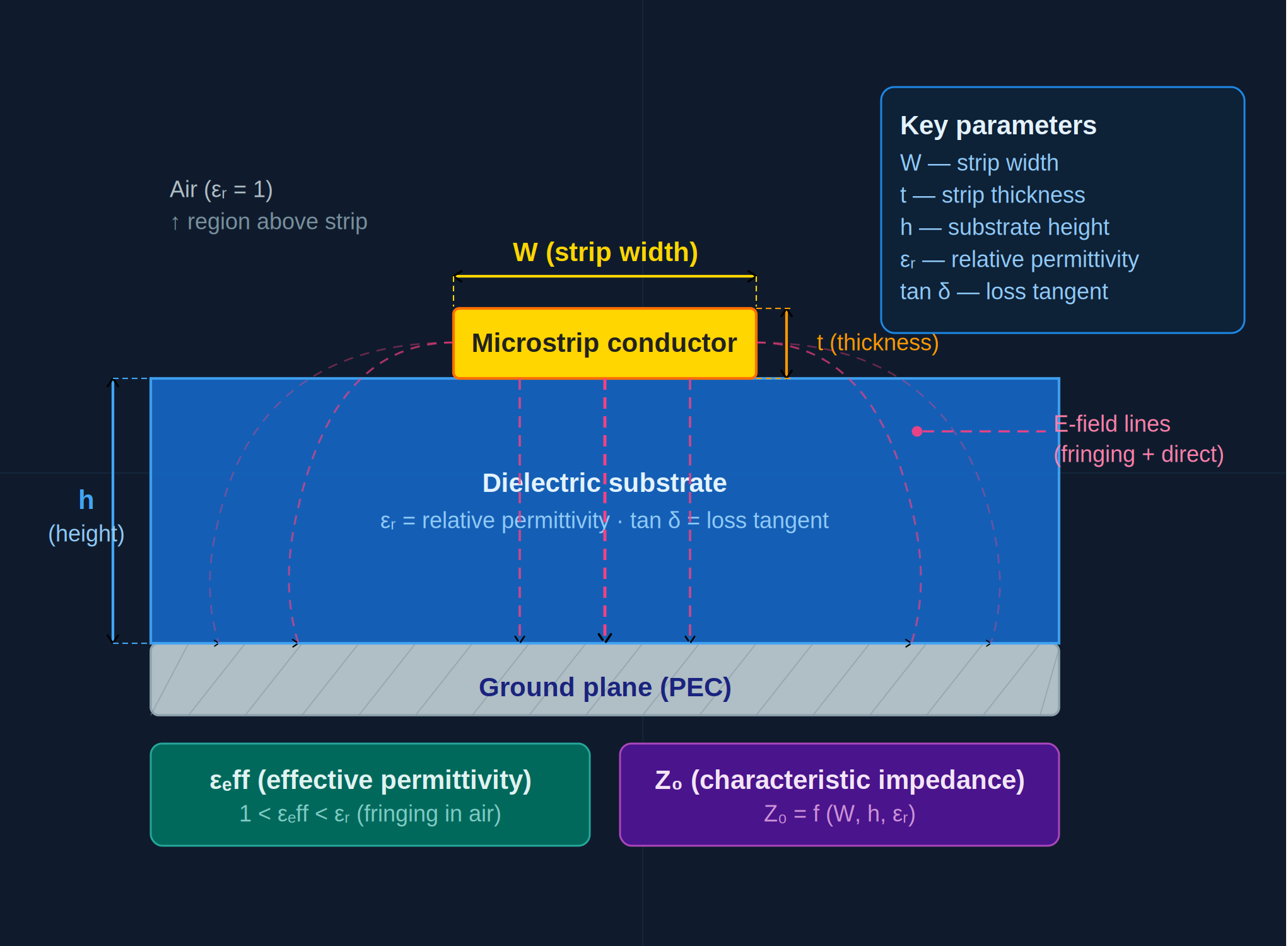
Part 2: what a transmission line is, the definition of characteristic impedance Z₀ = √(L/C), voltage and current on a line, Z₀ of coaxial cables and microstrip lines, why 50 Ω and 75 Ω systems are used, and the factors that change Z₀.

Read guide →
↩️
Beginner
RF Fundamentals

Understanding Load Impedance and Reflection Coefficient

Part 3: load impedance and reflections, the reflection coefficient Γ = (Z_L − Z₀)/(Z_L + Z₀), its magnitude and phase, short, open and matched loads, return loss, S11 and reflected power, with Smith Chart Calculator examples.

Read guide →
🌊
Intermediate
RF Fundamentals

Standing Waves and Voltage Standing Wave Ratio (VSWR)

Part 4: how standing waves form on a mismatched line, voltage maxima and minima, the definition of VSWR, conversions between VSWR, Γ, return loss and mismatch loss, the VSWR circle on the Smith chart, and why VSWR matters.

Read guide →
🔁
Intermediate
RF Fundamentals

Impedance Transformation Along Transmission Lines

Part 5: the input impedance of a transmission line, impedance transformation as rotation on the Smith chart, λ/8, λ/4 and λ/2 lines, the quarter-wave transformer, short- and open-circuited stubs, and physical line lengths.

Read guide →
🎯
Intermediate
RF Fundamentals

Introduction to the Smith Chart

Part 6: the purpose and history of the Smith chart, how it is constructed from the reflection-coefficient plane, its regions and special points, the impedance and admittance charts, and how to read the combined Z/Y chart.

Read guide →
➗
Intermediate
RF Fundamentals

Understanding Normalized Impedance on the Smith Chart

Part 7: normalised impedance and admittance (z = Z/Z₀, y = Y·Z₀), denormalising chart readings, changing the reference impedance from 50 Ω to 75 Ω, and converting normalised values into inductor and capacitor values.

Read guide →
⭕
Intermediate
RF Fundamentals

Understanding Smith Chart Parameters and Circles

Part 8: constant-resistance circles, constant-reactance arcs, constant-conductance and susceptance circles, constant-VSWR circles, the wavelengths-toward-generator scales, radially scaled parameters and constant-Q curves.

Read guide →
📍
Intermediate
RF Fundamentals

How to Plot Impedance on a Smith Chart

Part 9: a step-by-step method for plotting impedance on a Smith chart, reading Γ, VSWR and return loss, finding admittance, and following an impedance along a transmission line, with calculator screenshots.

Read guide →
🧩
Intermediate
RF Fundamentals

Impedance Matching Using the Smith Chart

Part 10: impedance matching with the Smith chart — conjugate matching, how series and shunt components move the impedance, step-by-step L-network design, four solutions for one load, component values, bandwidth and π/T networks.

Read guide →
🪛
Advanced
RF Fundamentals

Single-Stub and Double-Stub Impedance Matching

Part 11: single-stub and double-stub impedance matching — stub position and length on the Smith chart and analytically, short vs open stubs, microstrip lengths on FR-4, the double-stub forbidden region, and stub bandwidth.

Read guide →
📡
Advanced
RF Fundamentals

Practical Applications of Smith Charts in RF and Microwave Engineering

Part 12: practical Smith chart applications — matching a measured antenna from a Touchstone .s1p file, reading VNA sweeps, how cable loss hides a mismatch, port extension, and stability, gain and noise circles in amplifier design.

Read guide →
📡
Beginner
Antenna Fundamentals

Introduction to Antennas

Part 1 of the Antenna Fundamentals series: what an antenna is, why wireless needs one, radiation from accelerating charges, radiation resistance, receiving antennas and effective aperture, reciprocity, the antenna equivalent circuit and the main antenna families.

Read guide →

Have a Technical Question?

Reach out directly — we're a small team of RF engineers and we actually reply.