Antenna Fundamentals

Fourteen articles that take you from what an antenna is to how a complete radio link performs — radiation, field regions, patterns, gain, impedance, S11, efficiency, bandwidth, polarization and aperture — with full derivations, calculator results and ten worked examples in every part.

14 articles 6 hours of reading 140 worked examples Beginner → Advanced

Four Ideas Behind Every Antenna

The series is built on these four relationships. Each card links to the article that derives it.

Fourteen Parts in Five Stages

Each article builds on the one before it. Read them in order, or jump to the stage you need.

Real Results From Our Calculators

The patterns, impedances, S11 curves and power budgets in this series come from the free NEXT ANTENNAS calculators, and the worked examples check them against theory.

  • Dipole & Monopole: Method of Moments currents, impedance, S11, 3D patterns and loss budgets, over real ground.
  • Patch: synthesis on any substrate, linear or circular polarization, efficiency and axial ratio.
  • RF Exposure: power density, field regions and compliance distances against FCC and ICNIRP limits.
Open the Dipole Calculator →
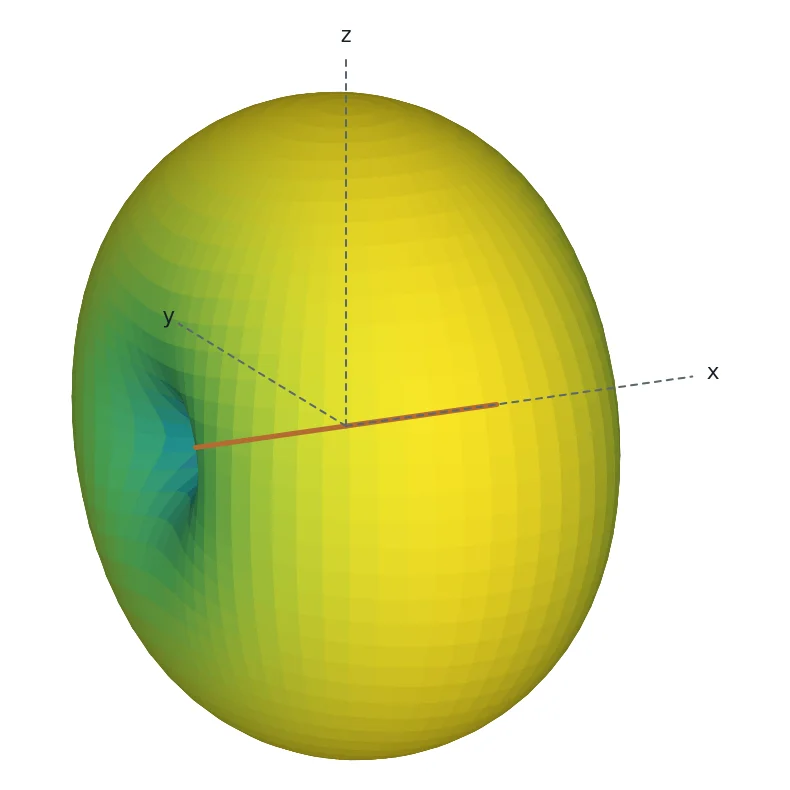
3D radiation pattern of a half-wave dipole computed by the Dipole and Monopole Antenna Calculator

After the Series You Can…

  • Explain how current on a conductor becomes a radiated wave, and derive the fields and radiation resistance of a dipole.
  • Decide whether a measurement point is in the near or far field, and estimate RF exposure from EIRP.
  • Read and derive radiation patterns, beamwidths, side lobes and directivity, and convert between dBi, dBd and realized gain.
  • Interpret antenna impedance, S11, VSWR, efficiency and bandwidth, and design simple matching networks.
  • Specify polarization and axial ratio, and compute polarization, mismatch and aperture factors in a link budget.
  • Choose and size the right antenna type — dipole, monopole, patch, horn, reflector, helix, Yagi or log-periodic — for a job.

Common Questions

What does the Antenna Fundamentals series cover?

It covers how antennas radiate and every standard antenna parameter: near and far field, radiation patterns, radiation intensity, directivity and gain, input impedance, reflection coefficient and return loss, efficiency, bandwidth and Q, polarization, effective aperture and effective length, the Friis transmission equation and the main antenna types.

What do I need to know before starting?

Algebra, trigonometry, complex numbers and basic calculus (simple integrals) are enough. Part 1 needs no prior RF knowledge; the derivations are worked step by step, and every article ends with ten worked examples.

What is the difference between directivity and gain?

Directivity describes how strongly an antenna concentrates its radiated power in one direction compared with an isotropic source. Gain is directivity multiplied by radiation efficiency, so it also accounts for conductor and dielectric losses. Realized gain additionally includes the impedance mismatch.

How is this series different from the Smith Chart and Maxwell series?

The Maxwell series explains the field theory underneath antennas, and the Smith Chart series explains matching. Antenna Fundamentals uses both to describe the antenna itself: how it radiates, how its performance is quantified and how those numbers enter a link budget. The articles link to the other series wherever they overlap.

Can I reproduce the results myself?

Yes. The screenshots come from the free NEXT ANTENNAS Dipole & Monopole, Patch and RF Exposure calculators, and the worked examples quote the same numbers, so you can rerun every case.

In what order should I read the articles?

In order from Part 1 if you are new to antennas. If you already know how antennas radiate, start at Part 4 for patterns and gain; if you mainly need impedance, matching and bandwidth, start at Part 7.

Start the Series

Part 1 explains what an antenna is and how it radiates — no prior RF experience needed.