What Is Antenna Gain?
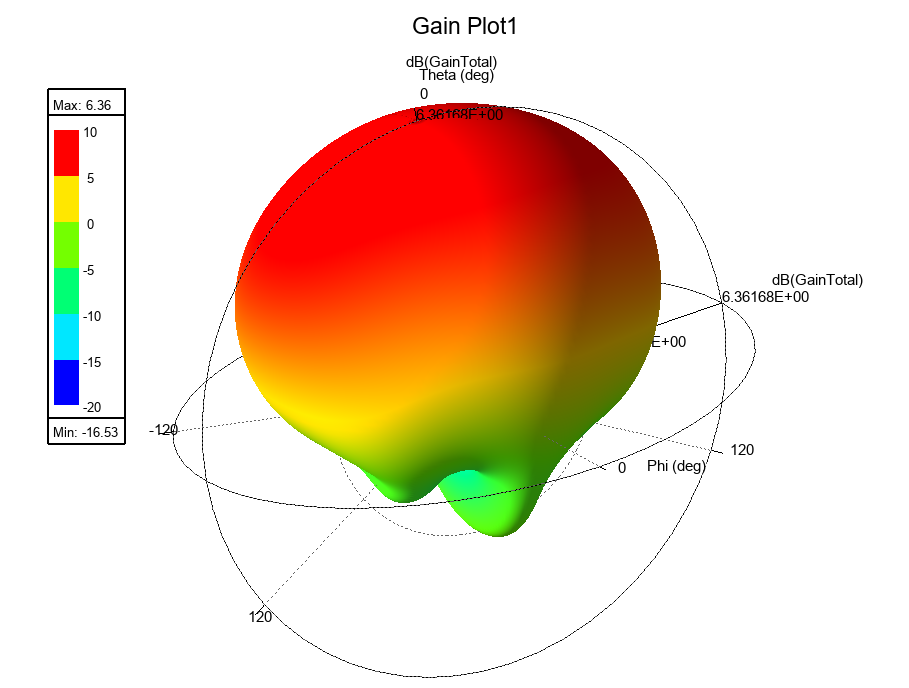
Antenna gain is one of the most cited — and most misunderstood — specifications in RF engineering. In plain terms, gain describes how well an antenna concentrates radiated energy in a particular direction compared to a reference antenna. It is not about adding power; it is about redirecting it.
Think of a light bulb versus a spotlight. Both consume the same wattage, but the spotlight delivers far more illumination in a narrow cone. An antenna with high gain works exactly the same way: it trades wide-area coverage for a stronger, more focused beam.
Gain is a passive property. An antenna cannot amplify power — it only redistributes it. Any antenna with positive gain in one direction must have reduced radiation in another.
dBi vs. dBd — What's the Reference?
Gain is always measured relative to something. The two most common references are:
- dBi (decibels relative to an isotropic radiator) — An isotropic antenna is a theoretical point source that radiates equally in all directions. Most datasheet values use dBi.
- dBd (decibels relative to a half-wave dipole) — A practical reference because a dipole is easy to build and measure. A dipole itself has about 2.15 dBi of gain, so: dBd = dBi − 2.15.
When comparing antennas from different manufacturers, always confirm which reference is used. A vendor quoting dBd numbers will appear to offer lower gain than one quoting dBi — even if the antennas are identical.
Directivity vs. Efficiency
Directivity
Directivity is a purely geometric quantity — it measures how non-uniform the radiation pattern is, ignoring any power losses inside the antenna. A perfectly lossless antenna with the same radiation pattern as a real antenna would have a directivity equal to the ratio of its maximum radiation intensity to the average intensity over all directions.
Radiation Efficiency
Real antennas have ohmic losses in their conductors, dielectric losses in substrates, and impedance mismatch losses at the feed point. Radiation efficiency η captures all of this:
Gain therefore combines both directivity and efficiency:
Practical Implications
Understanding the gain–directivity–efficiency relationship has direct design consequences:
- Link budget calculations — Always use the antenna's gain (not directivity) in your Friis transmission equation. Using directivity will give an overly optimistic received power estimate.
- Material selection — Low-loss conductors and substrates improve efficiency, which directly improves gain without changing the radiation pattern.
- Temperature effects — Conductor resistance rises with temperature. High-power installations can see gain degradation in hot environments if thermal management is insufficient.
- Measurement verification — Always verify manufacturer gain figures in an anechoic chamber or against a calibrated reference antenna.
Never add gain figures arithmetically — always work in dB when combining antenna gain with cable loss, amplifier gain, and free-space path loss in a link budget. Mixing linear and logarithmic numbers is a leading cause of system design errors.
How Much Gain Do You Need?
More gain is not always better. Higher gain means a narrower beamwidth, which has trade-offs:
- Point-to-point links — Use high-gain directional antennas (parabolic dishes, Yagis) to maximise range and reduce interference from other directions.
- Cellular base stations — Moderate gain (15–18 dBi) sector antennas balance coverage area with signal strength for moving users.
- IoT and wide-area coverage — Low-gain omnidirectional antennas (0–3 dBi) ensure devices can communicate regardless of orientation.
- Mobile platforms — Vehicles, aircraft, and ships need wide beamwidths to maintain links during movement; excessive gain creates pointing loss.
Summary
Antenna gain is a measure of how effectively an antenna focuses energy in a desired direction, always relative to a stated reference (isotropic or dipole). It combines the antenna's directivity with its radiation efficiency. When specifying or comparing antennas:
- Always clarify whether gain is quoted in dBi or dBd
- Distinguish between gain and directivity — they are not interchangeable
- Choose gain level based on system geometry and mobility requirements
- Use gain (not directivity) in link budget calculations
For hands-on calculations, visit our Antenna Gain Calculator or Link Budget Calculator.