From first principles to advanced beamforming — our library of guides, tutorials, and deep-dives is free for engineers, students, and enthusiasts worldwide.
Structured topic guides — each covers a complete subject area with articles, equations, and worked examples.
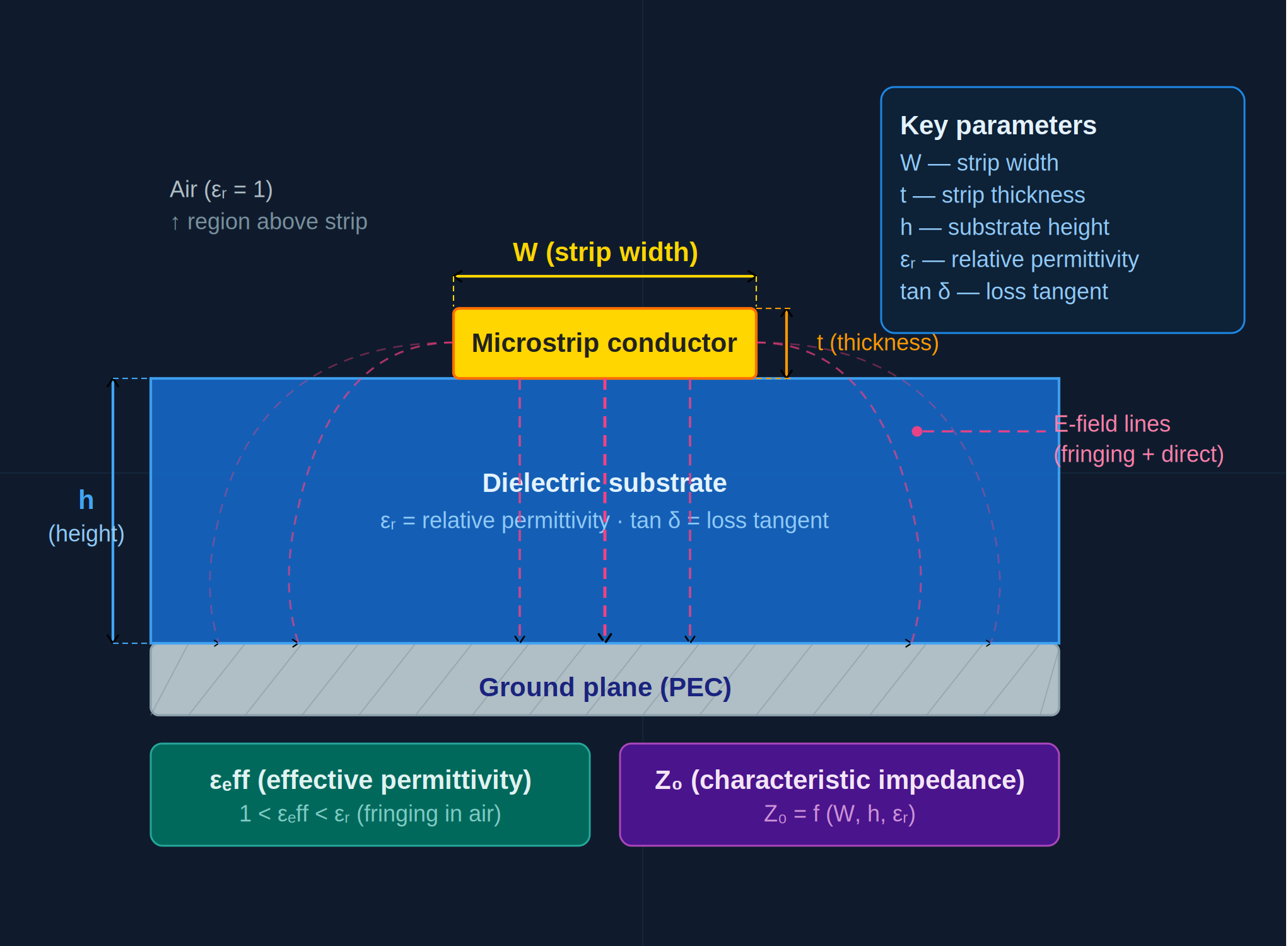
Wave propagation on guided structures — characteristic impedance, reflection, standing waves, and microstrip design.
A practical guide to the most common antenna types — how each works, where it's used, and how to choose the right one for your application.
From electric and magnetic fields to the four equations, electromagnetic waves and boundary conditions — and how they shape lines, waveguides and antennas.
From impedance, reflection coefficient and VSWR to reading the Smith chart and designing L-network and stub matches for real antennas.
How antennas radiate, and every parameter that describes them — patterns, directivity and gain, impedance, S11, efficiency, bandwidth, polarization, aperture and the Friis link.
Part 2: how antennas radiate — the radiation field of an accelerating charge, the retarded vector potential, the exact fields of a Hertzian dipole, near and far fields, wave impedance, dipole patterns of any length and the effect of ground.
Read guide →Part 3: the reactive near field, radiating near field and far field of an antenna, with the boundaries 0.62√(D³/λ) and 2D²/λ derived, E and H in each region, near-field vs far-field measurement and RF-exposure applications.
Read guide →Part 4: antenna radiation patterns derived from the current — dipole and array patterns, 3D and 2D plots, E- and H-plane, lobes, HPBW, FNBW, side-lobe level, beam steering, grating lobes, front-to-back ratio and pattern measurement.
Read guide →Part 5: Poynting's theorem and the time-average power density, steradians, radiation intensity U = r²S, total radiated power, beam solid angle, isotropic sources, EIRP and field-strength formulas, with RF-exposure examples.
Read guide →Part 6: antenna directivity and gain derived — D = 4π/Ω_A for dipoles, cosⁿ patterns and arrays, dBi vs dBd, gain and efficiency, realized gain, Kraus and Tai–Pereira beamwidth formulas, directivity limits and gain measurement.
Read guide →Part 7: antenna input impedance from the power balance, radiation resistance of the half-wave dipole, loss resistance and skin effect, reactance and stored energy, the series-RLC model, resonance, and dipole and monopole impedance vs length.
Read guide →Part 8: the antenna reflection coefficient derived, return loss, VSWR and mismatch loss, accepted power, reading S11 plots, how cables hide mismatch, and L-network and quarter-wave matches for real antennas.
Read guide →Part 9: radiation, mismatch and total efficiency — conductor loss from the surface current, dielectric loss and loss tangent, efficiency from Q, small antennas and loading coils, ground loss, and Wheeler-cap measurement.
Read guide →Part 10: impedance, pattern, gain and polarization bandwidth, fractional and ratio bandwidth, the −10 dB criterion, bandwidth from Q derived, the Chu limit, the Bode–Fano limit and bandwidth-enhancement techniques.
Read guide →Part 11: the polarization ellipse derived, linear, circular and elliptical polarization, RHCP and LHCP, axial ratio, polarization loss factor, co- and cross-polarization, reflection and Faraday rotation.
Read guide →Part 12: effective aperture A_e = Gλ²/4π derived from reciprocity, physical aperture and aperture efficiency, received power, effective length and effective height, received voltage and the EMC antenna factor.
Read guide →Part 14: antenna types with design equations — dipoles, monopoles, loops, horns, slots, microstrip patches, reflectors, helices, spirals, Yagi-Uda, log-periodic, dielectric resonator, travelling-wave and UWB antennas.
Read guide →Reach out directly — we're a small team of RF engineers and we actually reply.