Browse by Topic
Learning Paths
Structured topic guides — each covers a complete subject area with articles, equations, and worked examples.
Foundations
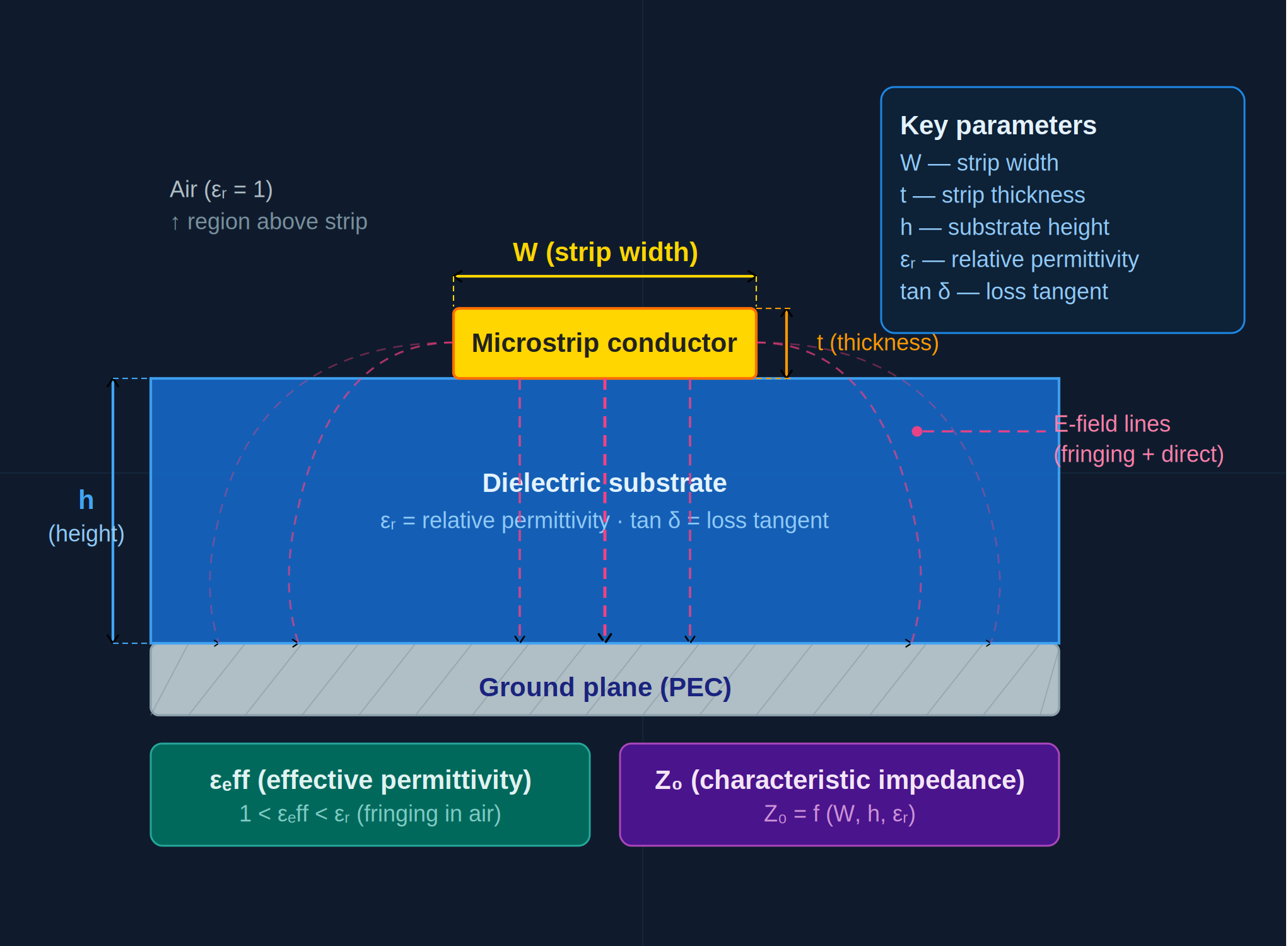
Transmission Line Theory
Wave propagation on guided structures — characteristic impedance, reflection, standing waves, and microstrip design.
Microstrip
Impedance
VSWR
εeff
Stripline
Explore topic →
Antenna Design
Antenna Types
A practical guide to the most common antenna types — how each works, where it's used, and how to choose the right one for your application.
Patch
Dipole
Yagi-Uda
Horn
Helix
Arrays
Explore topic →
Electromagnetics · 10-Part Series
Maxwell's Equations
From electric and magnetic fields to the four equations, electromagnetic waves and boundary conditions — and how they shape lines, waveguides and antennas.
Gauss's Law
Faraday
Ampère–Maxwell
EM Waves
Boundaries
Explore topic →
RF Fundamentals · 12-Part Series
Smith Chart & Impedance Matching
From impedance, reflection coefficient and VSWR to reading the Smith chart and designing L-network and stub matches for real antennas.
Impedance
Γ & VSWR
Smith Chart
L-Networks
Stubs
Explore topic →