From first principles to advanced beamforming — our library of guides, tutorials, and deep-dives is free for engineers, students, and enthusiasts worldwide.
Structured topic guides — each covers a complete subject area with articles, equations, and worked examples.
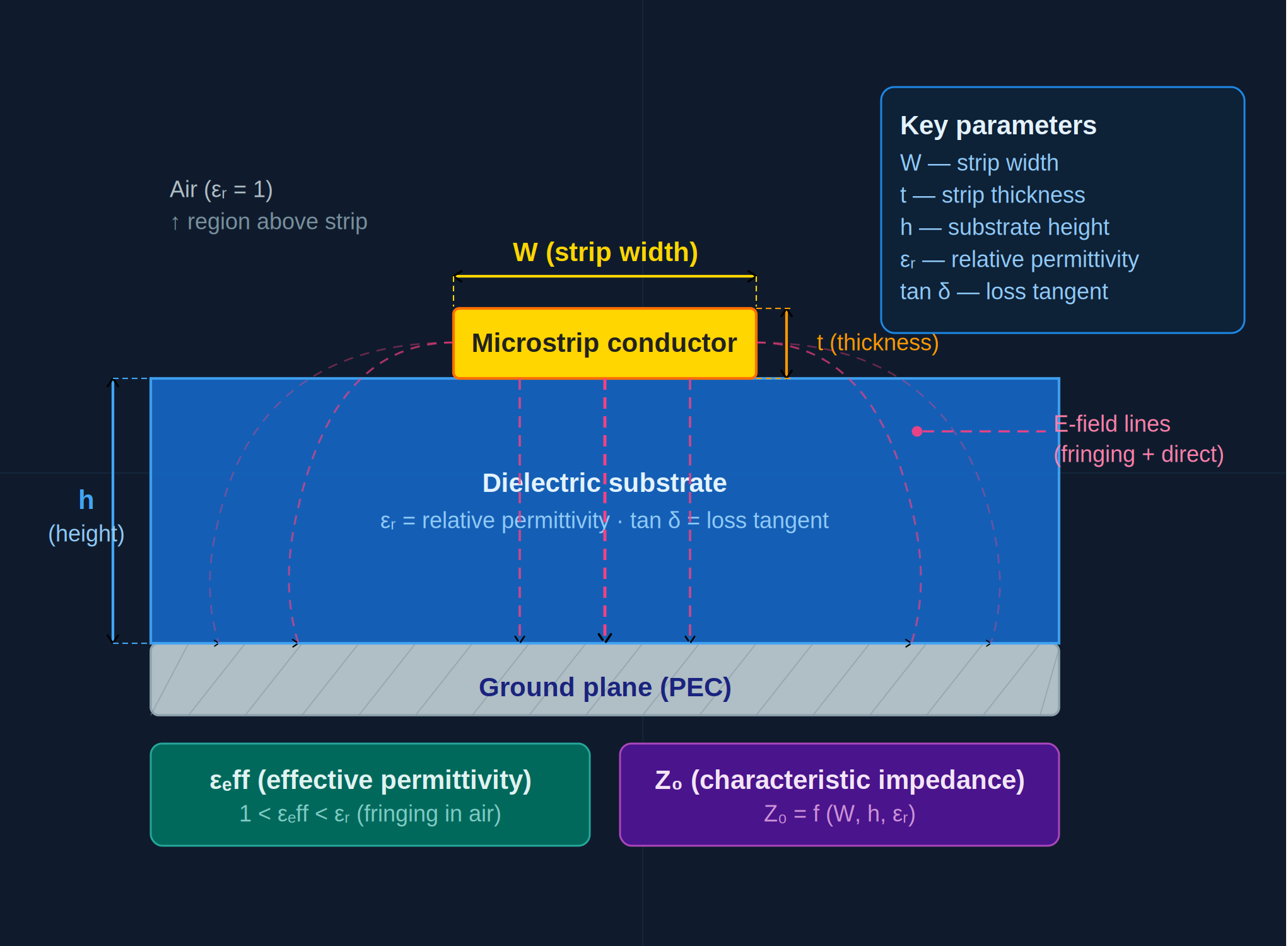
Wave propagation on guided structures — characteristic impedance, reflection, standing waves, and microstrip design.
A practical guide to the most common antenna types — how each works, where it's used, and how to choose the right one for your application.
From electric and magnetic fields to the four equations, electromagnetic waves and boundary conditions — and how they shape lines, waveguides and antennas.
From impedance, reflection coefficient and VSWR to reading the Smith chart and designing L-network and stub matches for real antennas.
Why a wire is not just a wire at RF frequencies — when lumped-circuit models break down, electrical length, the main types of transmission lines, and how signals propagate along them.
Read guide →Part 1 of the LNA series. What an LNA is and where it is used, the RF receiver chain, thermal and shot noise, the −174 dBm/Hz noise floor, noise figure, noise factor, the Friis cascaded noise formula, three power gain definitions, and input vs noise matching.
Read guide →Part 2 of the LNA series. The four noise parameters (NF_min, R_n, Γ_opt), noise and gain circles on the Smith chart, Rollett stability factor and μ-factor, all major LNA topologies from common-source to current-reuse, lumped and distributed impedance matching, P1dB, IIP3, and SFDR.
Read guide →Part 3 of the LNA series. Biasing techniques and power trade-offs, CMOS vs GaAs vs GaN vs SiGe technology comparison, broadband LNA techniques, the seven-step practical design flow, ADS/HFSS/Cadence simulation, NF and S-parameter measurement, cryogenic and mmWave LNAs, noise cancellation, machine learning in RF, and a complete design trade-off summary table.
Read guide →Barkhausen criteria, feedback and negative-resistance oscillation models, Colpitts, Hartley, and cross-coupled LC VCO topologies, crystal oscillators, phase noise and Leeson's equation, varactor tuning, K_VCO, tuning range, ring oscillators, VCO figure of merit, and PLL integration.
Read guide →A rigorous derivation from first principles — the distributed RLGC circuit model, Kirchhoff's voltage and current laws, the wave equation, propagation constant γ = α + jβ, characteristic impedance Z₀, and travelling voltage and current waves.
Read guide →Reach out directly — we're a small team of RF engineers and we actually reply.