From first principles to advanced beamforming — our library of guides, tutorials, and deep-dives is free for engineers, students, and enthusiasts worldwide.
Structured topic guides — each covers a complete subject area with articles, equations, and worked examples.
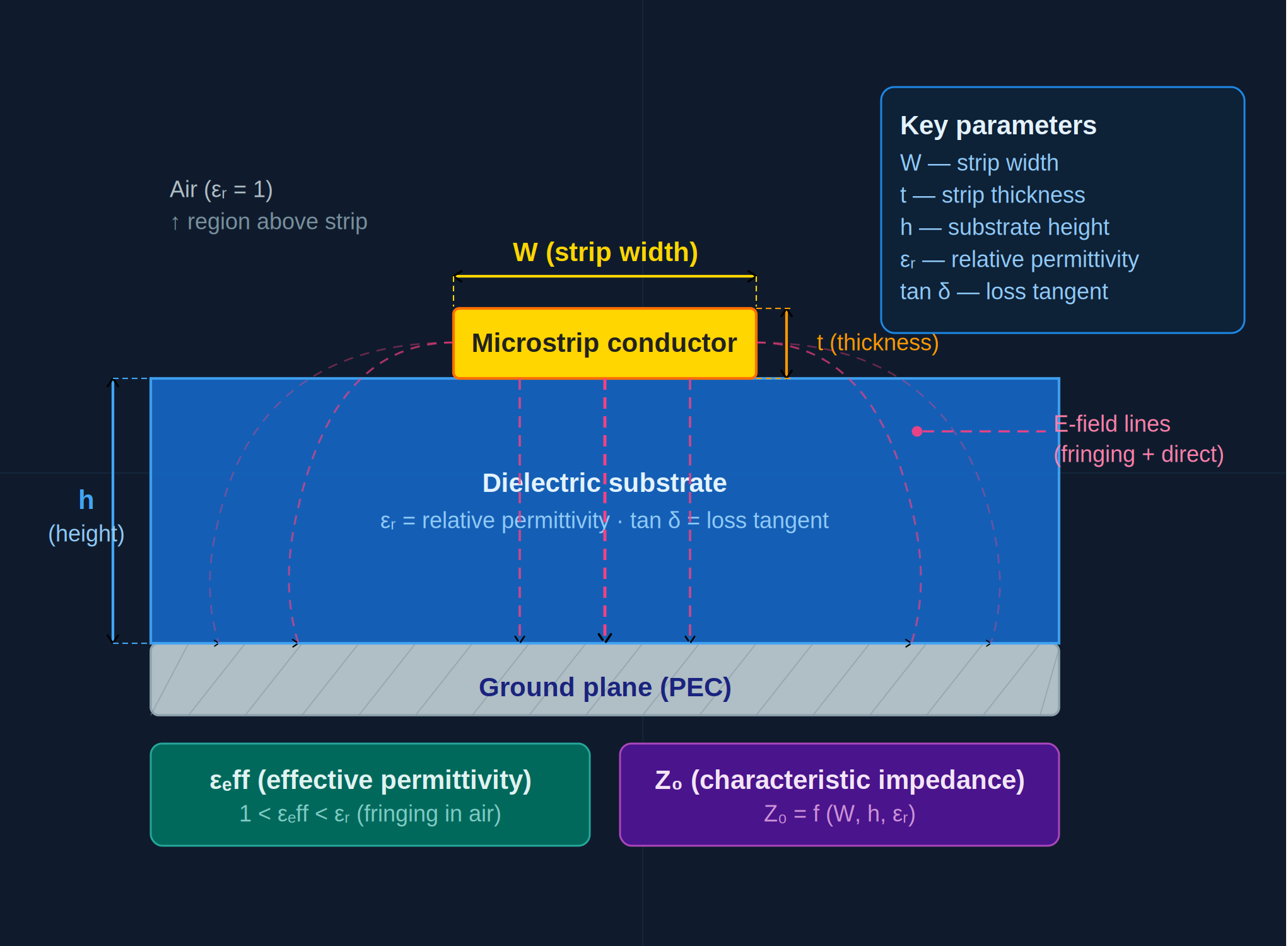
Wave propagation on guided structures — characteristic impedance, reflection, standing waves, and microstrip design.
A practical guide to the most common antenna types — how each works, where it's used, and how to choose the right one for your application.
From electric and magnetic fields to the four equations, electromagnetic waves and boundary conditions — and how they shape lines, waveguides and antennas.
From impedance, reflection coefficient and VSWR to reading the Smith chart and designing L-network and stub matches for real antennas.
How antennas radiate, and every parameter that describes them — patterns, directivity and gain, impedance, S11, efficiency, bandwidth, polarization, aperture and the Friis link.
Understand radiation patterns, antenna gain, directivity, polarisation, and the fundamentals of how antennas radiate and receive electromagnetic energy.
Read guide →A practical introduction to frequency, wavelength, the electromagnetic spectrum, free-space path loss, and the physics behind radio wave propagation.
Read guide →A complete practical guide to decibels in RF engineering — what dB, dBm, dBi, dBd, and dBW mean, how to convert between them, and how to apply them in link budgets, noise calculations, and antenna gain comparisons.
Read guide →A complete practical guide to impedance matching in RF engineering — covering VSWR, reflection coefficient, the Smith chart, L-networks, quarter-wave transformers, stub matching, and practical techniques for minimising return loss.
Read guide →How resistors, capacitors, and inductors really behave at radio frequencies — parasitic models, self-resonance, impedance vs frequency graphs, and practical guidelines for selecting components in RF circuits.
Read guide →How much signal power arrives at a receiving antenna? The Friis equation connects transmit power, antenna gains, and free-space path loss into a single expression — the foundation of every wireless link budget.
Read guide →Reach out directly — we're a small team of RF engineers and we actually reply.