From first principles to advanced beamforming — our library of guides, tutorials, and deep-dives is free for engineers, students, and enthusiasts worldwide.
Structured topic guides — each covers a complete subject area with articles, equations, and worked examples.
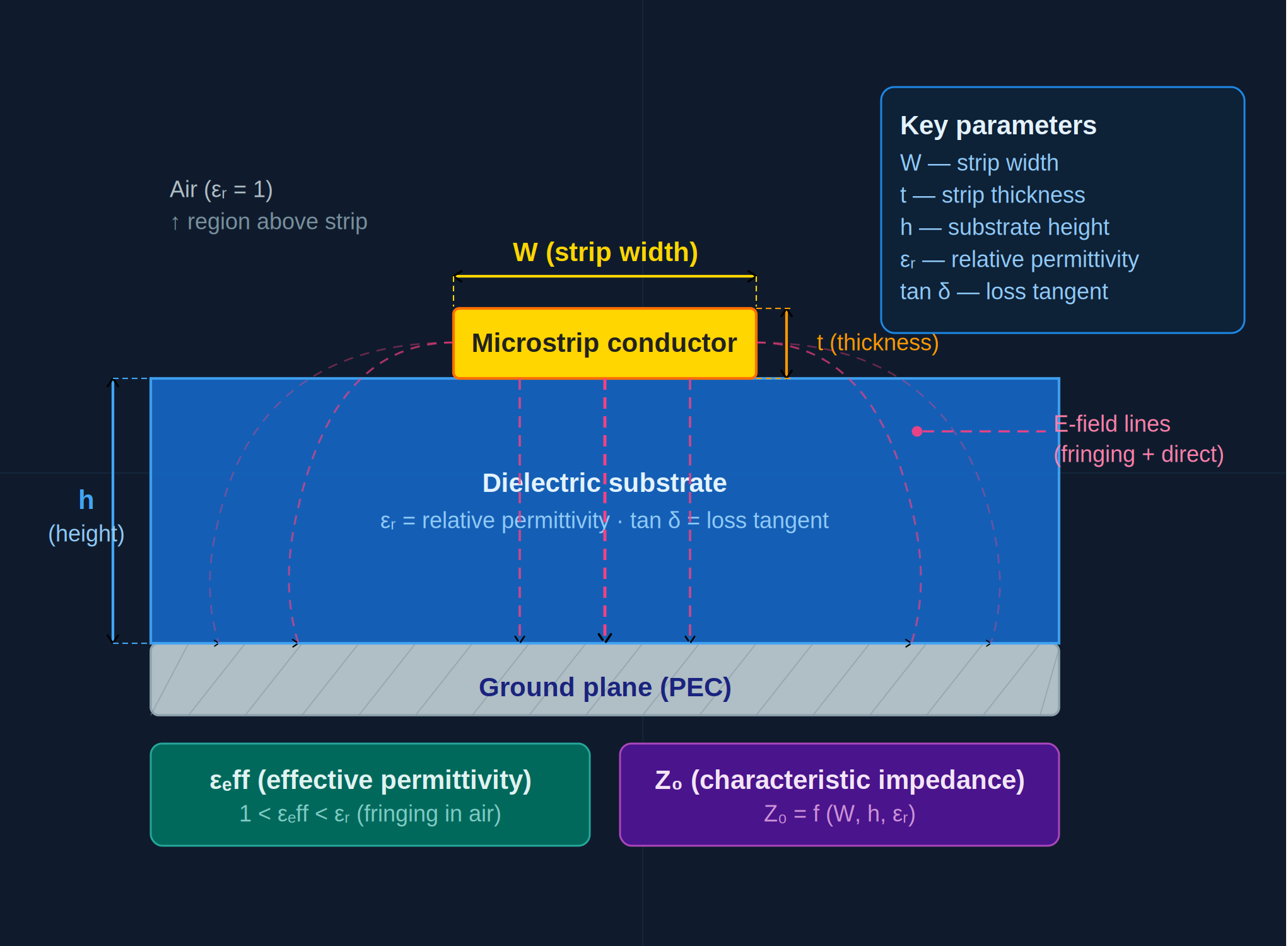
Wave propagation on guided structures — characteristic impedance, reflection, standing waves, and microstrip design.
A practical guide to the most common antenna types — how each works, where it's used, and how to choose the right one for your application.
From electric and magnetic fields to the four equations, electromagnetic waves and boundary conditions — and how they shape lines, waveguides and antennas.
From impedance, reflection coefficient and VSWR to reading the Smith chart and designing L-network and stub matches for real antennas.
How antennas radiate, and every parameter that describes them — patterns, directivity and gain, impedance, S11, efficiency, bandwidth, polarization, aperture and the Friis link.
Part 1 of the Maxwell's equations series: electric and magnetic fields, field intensity, field lines, Coulomb and Biot–Savart laws, the Lorentz force, electric vs magnetic fields, an introduction to electromagnetic waves, and why field theory matters in RF engineering.
Read guide →Applying boundary conditions to a lossless line with an arbitrary load — voltage reflection coefficient, input reflection coefficient, input impedance formula, quarter-wave transformer, stub reactances, standing wave patterns, and VSWR.
Read guide →Part 2: electric flux through flat and arbitrary surfaces, Gaussian surfaces, Gauss's law in integral and differential form, fields of point charges, charged spheres and conducting spheres, and the electric field and capacitance of a coaxial cable.
Read guide →Part 3: magnetic flux and its units, flux linkage, magnetic field lines, Gauss's law for magnetism (∮B·dA = 0, ∇·B = 0), why magnetic monopoles do not exist, and magnetic flux in inductors, transformers and RF components.
Read guide →Part 4: the discovery of induction, Faraday's law and its negative sign, Lenz's law, integral and differential forms, and applications in generators, transformers, inductive coupling, wireless power transfer, NFC and EMI.
Read guide →Part 5: magnetic fields of currents and the right-hand rule, enclosed current, Ampère's law in integral and differential form, fields of wires, solenoids, toroids and coaxial lines, coax inductance and characteristic impedance, and the law's limitations.
Read guide →Part 6: the capacitor charging paradox, current continuity, displacement current and its density, the Ampère–Maxwell law, how changing electric fields create magnetic fields, and displacement current in capacitors, wave propagation and RF dielectrics.
Read guide →Part 7: the history of Maxwell's equations, each of the four equations in integral and differential form with physical meaning and RF examples, integral vs differential form, constitutive relations (permittivity, permeability, conductivity) and how the equations work together.
Read guide →Part 8: what an electromagnetic wave is, step-by-step derivation of the wave equation from Maxwell's equations, the speed of light, wavelength and phase velocity, the 377 Ω impedance of free space, and propagation in dielectrics, lossy media and conductors (skin depth).
Read guide →Part 9: normal and tangential field components, boundary conditions for E, D, H and B derived from Maxwell's equations, surface charge and current, reflection and transmission at normal incidence, quarter-wave matching, and microstrip, antenna substrate and shielding applications.
Read guide →Part 10: Maxwell's equations applied to transmission lines (TEM, Z₀, standing waves), waveguides (TE/TM modes, cut-off), microstrip (ε_eff, quasi-TEM, filters, dividers), antennas (radiation, near/far field, patterns, polarisation, gain) and FEM/FDTD simulation in HFSS and other EM solvers.
Read guide →Part 1 of the Smith chart series: what impedance is, resistance and reactance, inductive and capacitive behaviour, real and imaginary parts, phasor notation, impedance in AC circuits and why impedance matters in RF engineering, with worked examples.
Read guide →Reach out directly — we're a small team of RF engineers and we actually reply.